
One of the most effective payroll scams is a simple email. It asks to switch the direct deposit for an employee to a new bank account before Friday. The safe response is to confirm the request by phone, using a number already on file, because a paycheck sent to the wrong account is very hard to get back.
Fraud is back in the headlines with a claim that 40% of Americans lost money to scams last year. The survey behind it says something different. Forty percent faced fraud or a scam, including attempts that failed, and about 11% of Americans lost money to scams.
What the Bankrate Survey Actually Found
The figure comes from a Bankrate press release on its fraud survey, published March 4, 2026. Respondents described the period since January 2025.
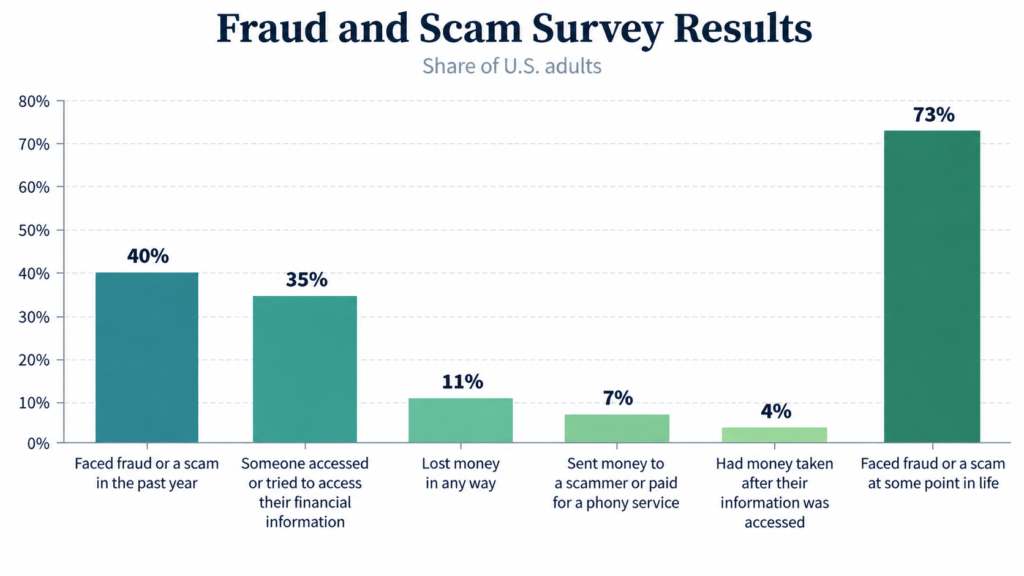
The 35% group mostly describes attempts. Bankrate says 93% of that group reported a failed attempt.
A blocked login or a declined charge is a nuisance and counts toward the 40%, but it costs nothing.
The trend is still moving in the wrong direction. A year earlier, the share facing fraud or a scam was 34%.
How Much Weight the Survey Can Carry
SSRS fielded the survey for Bankrate from January 16 to 20, 2026, interviewing 1,007 adults online and by phone.
Responses were weighted to match the U.S. adult population, the usual approach for a national poll.
A margin of error of plus or minus 3.5 percentage points means the true share of adults who faced fraud or a scam likely falls between about 36.5% and 43.5%.
That range is my own calculation from the published margin.
Subgroup figures carry wider margins. The full Bankrate fraud report found that 50% of white adults age 55 and older reported a scam attempt or a payment for a phony service, a 13-point jump from the prior year.
Smaller slices of a 1,007-person sample move around more from one year to the next. We treat that jump as a signal worth watching rather than a settled fact.
Gallup Measured Something Narrower
A separate Gallup and Stop Scams Alliance study surveyed 5,173 adults from January 8 to February 18, 2026.
Gallup counted only people deceived into losing money. Identity theft and fraudulent card charges were excluded unless the victim was personally fooled.

Under that stricter definition, the 2025 numbers look like this.
- About 6% of adults, roughly 15 million people, were personally scammed.
- Another 4% said someone else in their household was scammed.
- The average loss per scam was $5,578, yet 56% of scams involved $500 or less.
- Gallup estimates total losses at $68 billion, within a wide range of $33.1 billion to $114.1 billion.
A large gap between the average and the typical loss means a smaller number of big losses pulls the average up.
Most victims lose an amount that strains a monthly budget, while a smaller group loses savings.
What Government Reports Showed for 2025
Surveys estimate how common fraud is. Government agencies count what people actually report, which is a different measure and almost certainly an undercount.
| Source | Reports in 2025 | Reported losses | Notable detail |
|---|---|---|---|
| Federal Trade Commission | 3 million fraud reports | $15.9 billion | Investment scams cost $7.9 billion |
| FBI Internet Crime Complaint Center | 1,008,597 complaints | $20.877 billion | Adults 60 and older lost about $7.7 billion |
The two totals measure different complaint systems with different categories. Someone could report the same loss to both agencies, so adding them together would overstate the total.
Where the Losses Start
Social media has become the costliest starting point for fraud. The FTC found $2.1 billion in 2025 losses from scams that began on social media, about eight times the $261 million reported for 2020. Investment scams made up $1.1 billion of that amount.
Fake shopping ads produced the most reports among social media scams. Romance scams that started on social platforms cost people $298 million. Facebook led all platforms in reported losses, followed by WhatsApp and Instagram.
Bankrate also highlighted the broader findings of its financial fraud survey in a short video explaining how widespread scams have become.
View this post on Instagram
Did you know that text messages generated more fraud reports than any other contact method in fiscal 2025, according to FTC testimony before the Joint Economic Committee? Bank payments carried the largest losses, followed by cryptocurrency.
The agency also estimated that the full cost of fraud in 2024 could reach $195.9 billion once unreported cases are counted.
The Payment Scam Businesses Learn to Watch For
In accounts departments, vendor bank details are supposed to change rarely. A letter announcing new payment instructions should always get a phone call to a contact already on file, never to the number printed on the letter.
The FBI calls the business version of that scheme business email compromise. Its 2025 Internet Crime Report lists 24,768 such complaints and about $3.05 billion in losses.
Households face the same trick in different clothing, and many Americans lost money to scams this way in 2025. The FTC found that bank impersonators caused the highest losses among business imposters that year. Many used fake security alerts that pressured people to move money into a supposedly safe account. The safe account belongs to the scammer.
How You Paid Decides How Much Help You Get
Federal rules protect bank customers from transfers they did not make or allow. The CFPB explains that reporting a lost or stolen debit card within two business days caps your liability at $50. Waiting longer can raise it to $500, and missing the 60-day window after a statement can leave you responsible for later transactions.
Payments you approved because someone lied to you are harder. A transfer you sent yourself may not count as unauthorized, so ask your bank in writing how it will handle the claim.
Credit card issuers run their own dispute process, which is one reason we prefer a card for online shopping.
Pay the balance in full, though. With credit card interest rates still near 20%, a scam can turn into months of interest.
What to Do in the First Hours After a Loss
Speed is important. The same FBI report says its Recovery Asset Team froze about $679 million in 2025 and succeeded in 58% of the incidents it worked.

- Call your bank or card issuer using the number on the card, and ask whether the payment can be stopped or reversed.
- File a complaint with the FBI Internet Crime Complaint Center, especially for wire, bank transfer, or crypto losses.
- Report the scam through the FTC fraud reporting site.
- If someone got your Social Security number or logins, use the FTC identity theft recovery site and place a free credit freeze with Equifax, Experian, and TransUnion.
- Write down names, phone numbers, dates, payment methods, and where the money went.
Ignore anyone who promises to recover your money for a fee. The FTC warns that fake recovery services often target people who already lost money to investment scams.
Who Takes the Hardest Hit
Age made no measurable difference in its data, which surprised me, since fraud is so often framed as a retiree problem.
- 46% of scam-affected households reported moderate or severe financial hardship.
- Among households earning under $80,000, 28% reported severe hardship.
- 73% said the scam hurt their mental health or wellbeing.
For a family living near the median U.S. household income, a few hundred dollars can mean a late utility bill or a smaller grocery run.
Adults 60 and older still reported about $7.7 billion in losses to the FBI in 2025, a reminder that how often scams happen and how much they cost are separate questions.
A 10-Minute Check Worth Doing This Week
Put accurately, 4 in 10 adults faced fraud or a scam, and roughly 1 in 9 Americans lost money to scams. Most of the costliest losses begin with a message that looks routine.
The check takes about 10 minutes. Turn on transaction alerts, compare your budget against recent statements, and look up every charge you do not recognize.
Usually it turns out to be a forgotten subscription. Anything else deserves a call to the bank, using the number on the back of the card, never one from a text.