
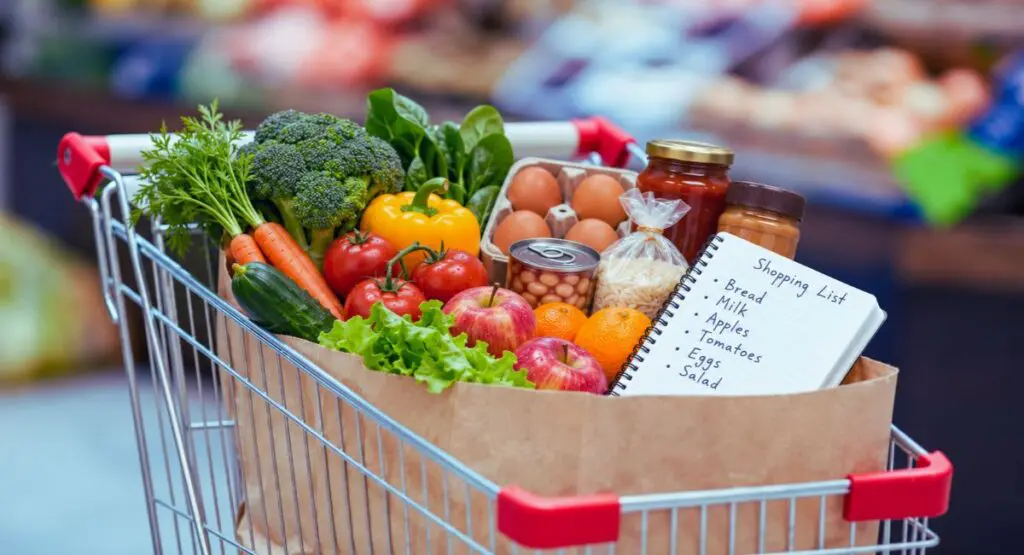
A grocery list short enough to fit on a sticky note sounds like a small miracle. The 5-4-3-2-1 rule offers exactly that, with a cap of 15 items spread across five food groups, and it has been passed around social media since 2023 as an easy way to spend less.
We wanted to know whether the savings hold up once the receipt arrives. Below, we explain what each number stands for, why different websites list different categories, and how a 15-item cart compares with the latest USDA figures on what groceries cost.
The short answer is yes, sometimes. Why it helps is less obvious than most posts suggest.
What the 5-4-3-2-1 Rule Asks You to Buy
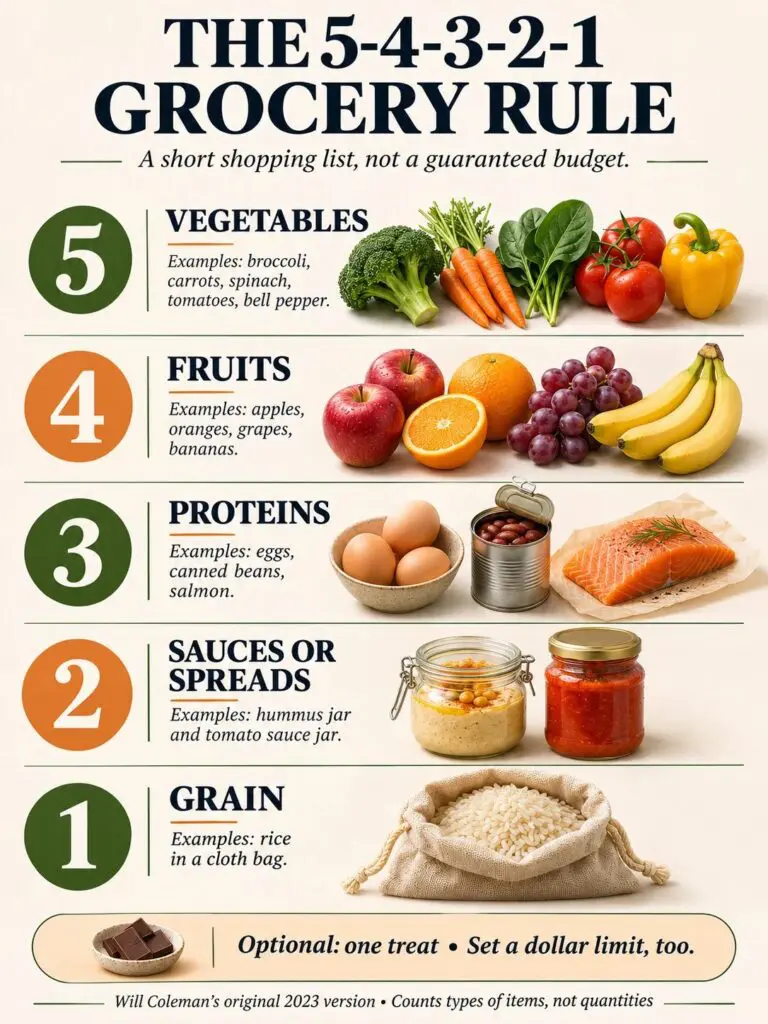
Each number is a count of different items, not pounds or packages. A 2-pound bag of carrots and a single head of broccoli count as two vegetable picks, whatever their size.
Where versions split is the last three slots. Healthline’s 2025 explainer, for example, puts proteins ahead of fruit.
Coleman’s own version has a single grain and treats dessert as a bonus rather than a counted slot.
Posts listing “two carbs and one treat” describe a later remix. Neither version is wrong. Still, when a post promises specific savings, check which version it actually tested.
Where the Rule Came From
Chef and food creator Will Coleman introduced the 5-4-3-2-1 method in a TikTok video posted in July 2023.
Chef Will Coleman explains his original 5-4-3-2-1 grocery shopping method.
Source: @chefwillco / TikTok.
Coleman aimed it at beginners who leave the store with a full cart and nothing to cook.
He later promoted a larger 6-to-1 version with six vegetables, five fruits, four proteins, three starches, two sauces, and one fun item.
Chef Will Coleman explains how his grocery shopping method evolved
from the original 5-4-3-2-1 rule to the expanded 6-to-1 approach.
Source: @chefwillcoleman / Instagram.
Some websites now tell the story backward, calling 5-4-3-2-1 a trimmed version of 6-to-1.
The posting dates suggest otherwise, and the mix-up shows how a viral tip changes shape as it travels.
The 5-4-3-2-1 rule is a list-building method, not a budget. It limits how many different items you buy. It sets no dollar amount, no quantity, and no price ceiling.
Grocery receipts care about pounds and prices, and the rule says nothing about either.
Hold on to that distinction as we get to the money question.
How the Rule Can Lower a Grocery Bill
Savings, when they show up, come from three habits the rule encourages.
Three ways the rule may save money
- Fewer unplanned purchases. A fixed count gives you a reason to walk past the endcap display.
- Ingredients that overlap. Five vegetables only stretch across a week if several meals share them, so the rule pushes you toward planning.
- Less food thrown away. USDA estimates the average family of four loses $1,500 a year to uneaten food.
That last figure deserves a closer look, because it works as a ceiling. Divide $1,500 by 52 weeks and you get about $29 a week. A family that cut waste to zero would save roughly that much, and no shopping rule gets anyone to zero.
The $29 is our own arithmetic on a USDA estimate, not a measured result. Real savings depend on how much a household was wasting to begin with.
What the Rule Leaves Out
Fifteen items rarely cover a whole week. The list skips several things that appear on almost every real receipt.
Expenses the rule does not account for
- Pantry staples such as oil, flour, spices, broth, and condiments
- Dairy, unless you count milk or yogurt as a protein
- Household goods like paper towels and dish soap
- Quantities, so a family of five and a single shopper get identical instructions
- Prices, so three proteins could mean dried lentils or three cuts of steak
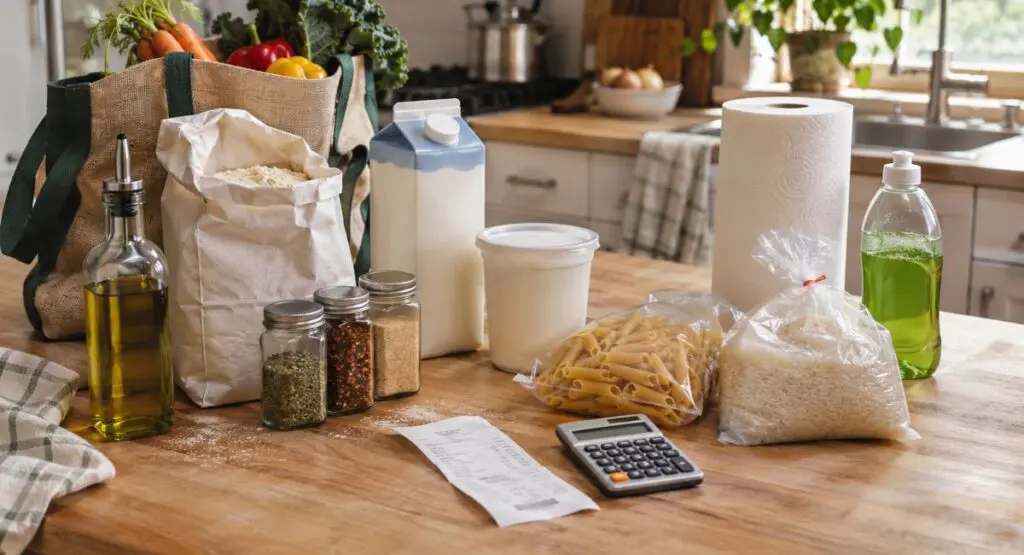
One Reader’s Digest writer who tested the method reported a bill of about $70, then noted that milk, eggs, pasta, and rice were already in her kitchen.
Totals posted online often look low for that reason. Before comparing your bill with one, ask what was already in the pantry.
How a 15-Item Cart Compares With USDA Benchmarks
USDA publishes monthly food plans that price a nutritious diet cooked entirely at home, at four cost levels. The September 2026 figures below are weekly costs for one adult in a four-person household.
USDA suggests adding 20% for someone who lives alone. On the Thrifty plan, that puts a single woman at about $70.32 a week and a single man at about $88.32.
A reference family of four on the same plan comes to $236.30 a week, or $1,024 a month.
Yes, the Low-Cost figure for men sits below the Thrifty one. The plans use market baskets built from different years of data.
A receipt near the corresponding benchmark provides useful context for your grocery budget, although it does not by itself prove that the shopping rule saved money.
Grocery Prices That Will Shape Your Picks
USDA’s Economic Research Service updated its Food Price Outlook on October 23, 2026.
Grocery prices in September 2026 were 1.8% higher than a year earlier, and food-at-home prices are forecast to rise 2.3% across all of 2026.
Fresh vegetables are projected to rise 5.8%, beef and veal 8.7%, and fresh fruits 2.9%.
Eggs are forecast to fall 29.3% after years of bird flu price spikes, which could make them a more affordable protein choice.
Treat every number here as a projection, not a promise.
Did You Know?
Sugar and sweets, the category that includes most chocolate candy, are forecast to rise 6.5% in 2026, faster than most groceries. The single treat on your list may be the item with the steepest price increase in the cart.
Our Take on Who Should Try It
We think the rule works best as a training exercise for people who buy more than they cook.
If you often toss wilted spinach or discover three open jars of salsa, a 15-item cap forces the planning that saves money. Households already cooking from a plan may see little change.
We would adjust it in two ways. First, set a dollar target alongside the item count, using the USDA figures above.
Second, choose proteins after checking prices, since dried beans and steak are very different budget decisions.
Groceries also sit inside a bigger picture. Our look at what a record household income actually buys shows how food competes with housing and transportation.
And when groceries go on a card you cannot clear each month, credit card interest rates near 20% can erase whatever the rule saves.
What Readers Ask
One Number to Check Before Your Next Trip
Before trying the rule, pull up your last four grocery receipts and add them up. Divide by four for a weekly average, then compare it with your household’s USDA figure above.
If you are well above the Thrifty or Low-Cost level, the 5-4-3-2-1 rule gives you a simple structure to test for a month. Keep the receipts, note what you threw away, and run the comparison again.
Should the total drop, the rule earned its place on your fridge. If it does not, the item count was never the problem, and price per pound deserves a closer look.