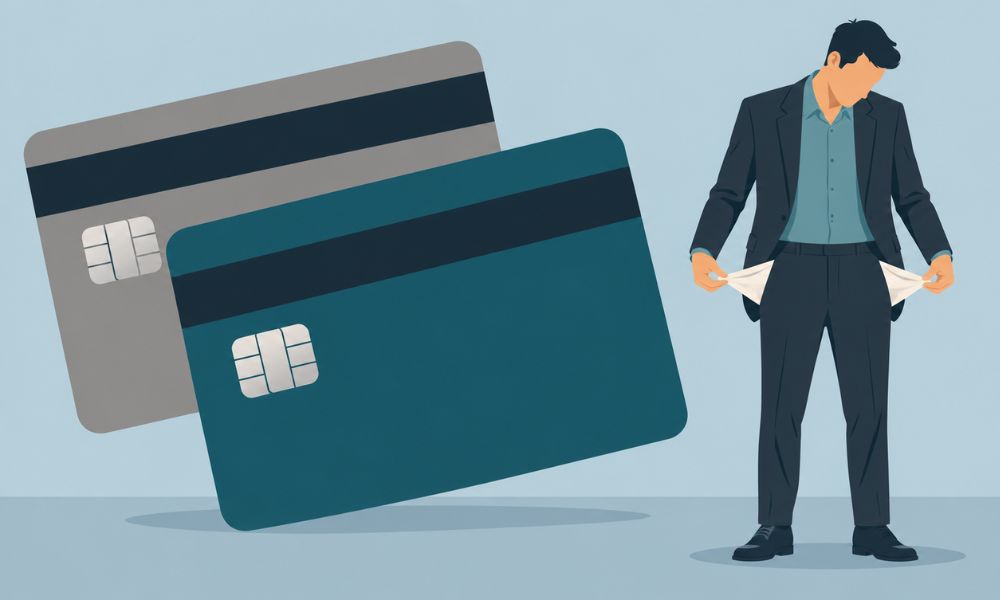
Some money habits look responsible from one side of the spreadsheet and ridiculous from the other.
A common one is keeping money in savings because it feels secure, while carrying a credit card balance that charges far more interest than the savings account earns. Run the numbers, and the math is not impressed.
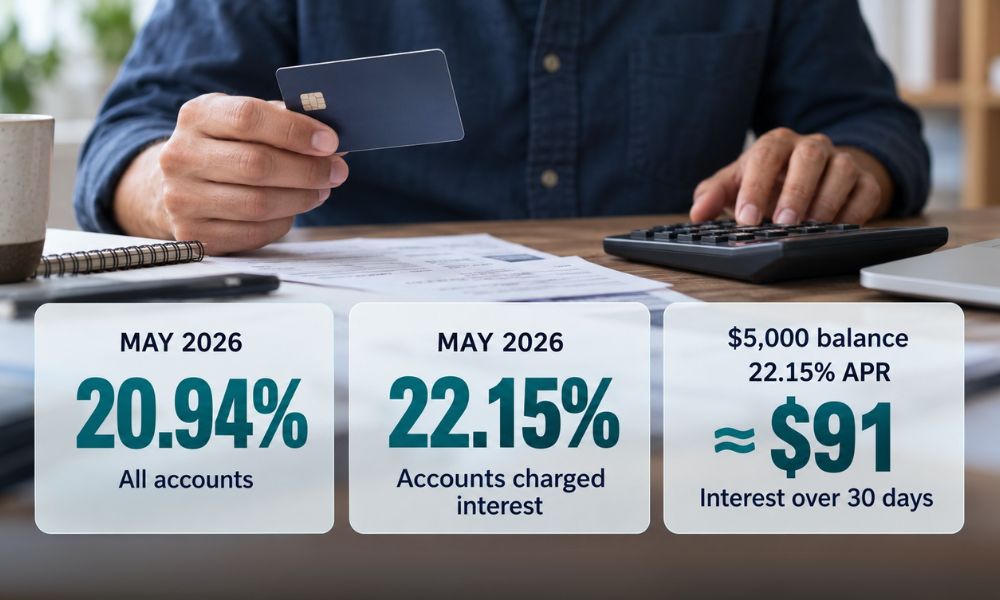
That habit is more expensive now. The latest credit card rate data from the Federal Reserve show an average APR of 20.94% across all accounts in May 2026.
For accounts actually charged interest, the average was 22.15%. Those percentages become very real when a balance follows you from month to month.
The first number to look at is 22.15%
The Federal Reserve publishes two credit card figures, and the difference is useful.
The average across all commercial-bank accounts includes cards that never incur interest.
The “accounts assessed interest” figure is closer to the experience of someone who actually carries debt.
| Period | All accounts | Accounts assessed interest |
|---|---|---|
| 2021 | 14.60% | 16.45% |
| 2024 | 21.58% | 22.89% |
| 2025 | 21.22% | 22.32% |
| May 2026 | 20.94% | 22.15% |
People who pay the statement balance in full can generally avoid purchase interest if they keep their grace period.
Why rates stayed high after the Fed started cutting

Most variable credit card APRs are built from a benchmark rate plus an issuer margin.
The benchmark moved sharply higher when the Federal Reserve raised rates in 2022 and 2023. The Fed later cut rates several times in 2024 and 2025, but card APRs remained high.
Margins are part of the explanation. The CFPB’s 2025 credit card market report found that the average APR margin on general-purpose cards tied to prime reached 16.4% in 2024, more than three percentage points above its 2015 level. The agency did not assign one motive to issuers, so we would not reduce that change to a slogan about banks refusing to cut rates.
Important: On September 16, 2026, the Federal Reserve raised its target range by 0.25 percentage point to 3.75% to 4.00%. The bank prime rate moved to 7.00% the next day.
What a 22% rate looks like in an ordinary month
Percentages become easier to respect when I turn them back into dollars.
If a card balance stayed around $5,000 for 30 days at a 22.15% APR, a rough interest estimate is about $91. Actual card interest depends on daily balances, billing-cycle length, payments, and the issuer’s method. The CFPB explains how daily interest calculations work.
That is the kind of number to think about when the car needs work, a child needs something unexpected, or two annual bills land together.
A credit card can bridge the gap. The expensive part begins when the bridge becomes the road.
We ran a five-year calculation to show what happens when you only make minimum credit card payments.
The results show how slowly the balance falls even when every payment is made on time.
- Find the purchase APR on the latest statement.
- Check the balance that is actually accruing interest.
- Look at how much interest was charged last month.
- Compare that cost with the amount you are paying above the minimum.
Don’t wait for rates to rescue the budget
Credit card balances reached $1.263 trillion in the second quarter of 2026, according to the New York Fed. That does not mean every cardholder is in trouble, but it shows how much household borrowing sits in an expensive category.
The national debt total is only part of the story. Our breakdown of credit card debt repayment timelines shows how a $6,610 balance can take nearly 19 years to clear when borrowers make only declining minimum payments.
Cash-flow problems rarely arrive with a neat label. A paycheck can be normal while childcare, insurance, repairs, and an irregular bill make one month ugly. Even a careful budget can hide a subscription that survived too long.
For anyone carrying a high-rate balance, working to reduce the rate or the balance usually beats waiting for rates to fall.
A balance transfer can help, but the CFPB warns about transfer fees and limited promotional periods. Before choosing one, compare the fee, the deadline, and the monthly payment needed to clear the balance before the regular rate returns.
The number we would check tonight
Skip the search for the national average. Open the latest statement and find your own APR, interest charge, balance, and minimum payment.
A national figure near 21% explains the environment, but your statement shows what that environment is costing you. A savings balance can feel reassuring while expensive debt quietly works against it.
Keeping cash available for the next repair or school expense still makes sense. Money earning a modest return and debt charging more than 20% are simply not financially neutral neighbors.