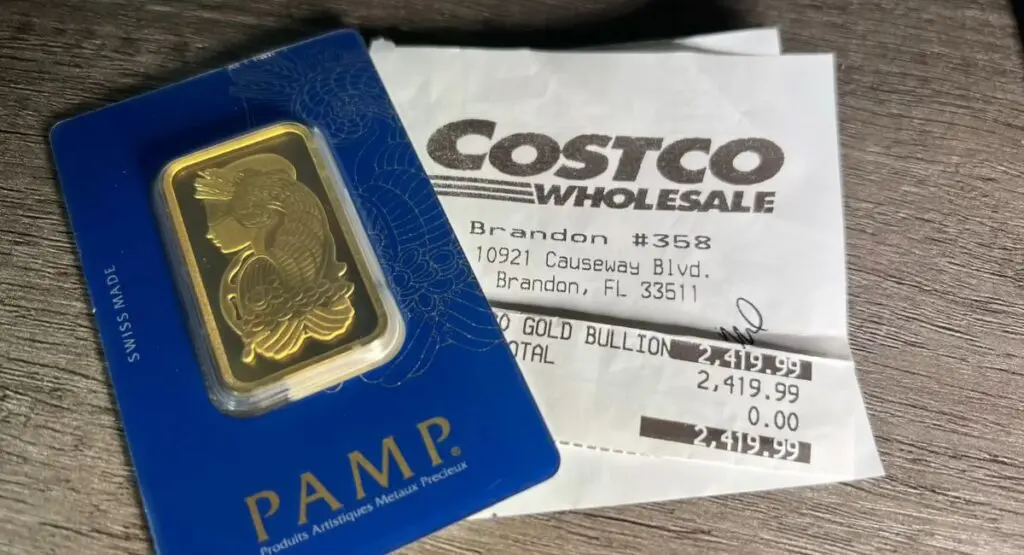
Costco has been selling 1-ounce gold bars since 2023, and they still sell out quickly.
With gold near $4,025 an ounce on October 29, 2026, many early buyers are sitting on large paper gains and wondering how to turn a bar back into cash.
Costco will not help with that part. Once a member buys a bar, the warehouse club neither refunds it nor buys it back, so every sale goes through a dealer or a private buyer.
Below, we look at where Costco bars can be sold, what a quick flip really earns, and how taxes change the final number.
October 29, 2026
One troy ounce
on long-term collectible gains
Costco Does Not Take Its Gold Back
Gold falls outside the famously generous Costco return policy.
A 2024 Wall Street Journal report on selling Costco gold noted that the bars come with no returns, refunds or price adjustments.
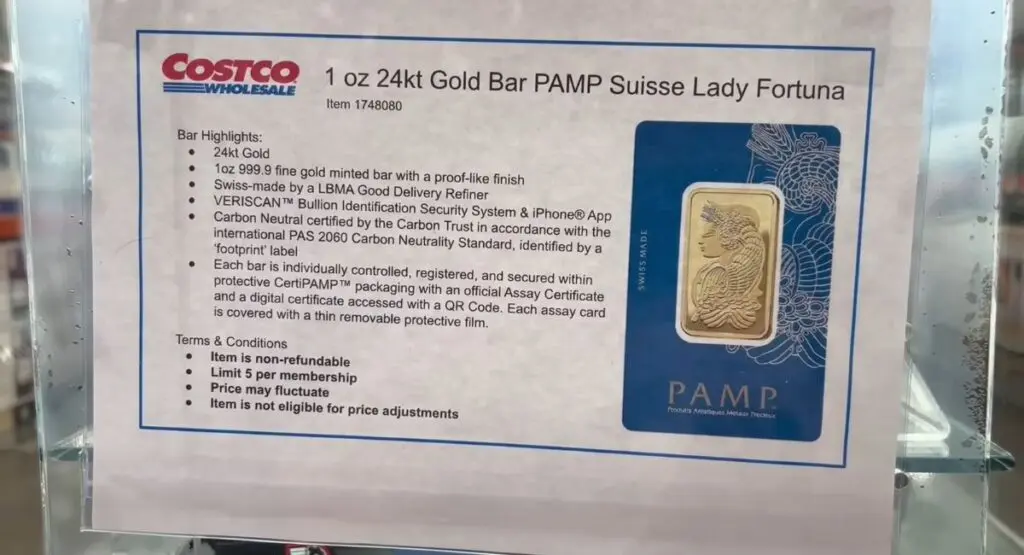
Demand stays strong anyway. In May 2025, Costco limited buyers to one transaction per membership and two bars per 24 hours.
The bars on offer at the time came from PAMP Suisse and Rand Refinery, both 1 troy ounce of 24-karat gold.
Spot price means the current market price for immediate delivery of one troy ounce of gold, about 1.1 ordinary ounces. Dealers sell above spot and buy below it, and the gap between those two prices is called the spread. A seller always deals with the lower number.
For Costco members, the spread is the whole story. Buying cheaply is only half the transaction.
Where a Costco Gold Bar Can Be Sold
Costco bars come from well-known refiners, so bullion buyers can identify them easily.
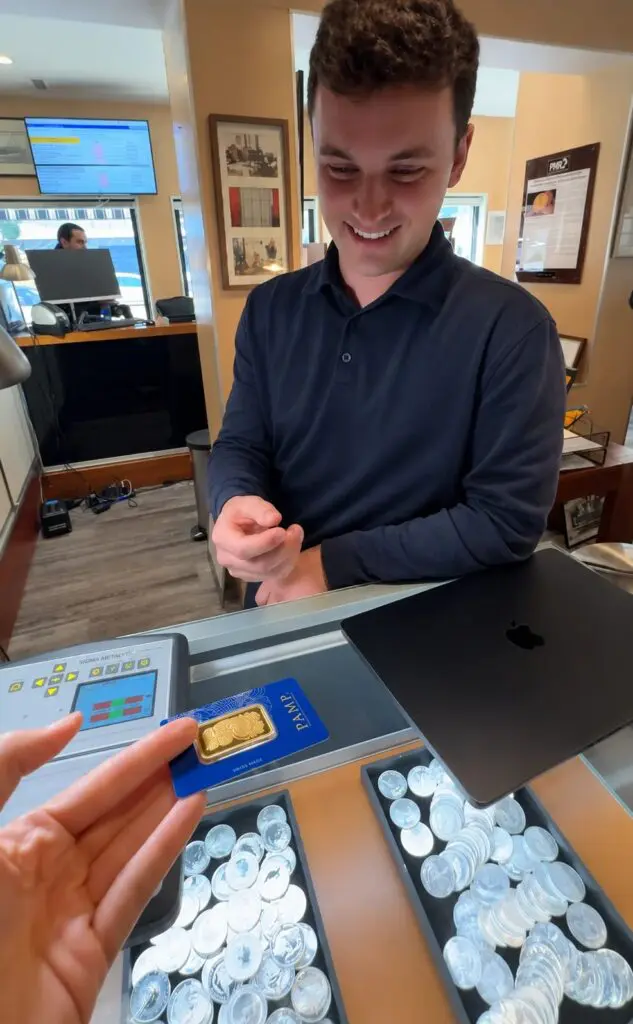
Prices still vary widely depending on where you sell and how quickly you want the money.
- Local bullion dealers. Brick-and-mortar shops may pay 1% to 5% below spot, with in-person testing and same-day payment, according to a 2025 New York Post report.
- Online bullion dealers. Sellers ship the bar insured, and the dealer verifies it within a few business days before paying.
- Private buyers and marketplaces. Offers typically land 5% to 10% below spot, and scam risk is higher.
- Pawn shops. They reportedly keep margins of 38% to 50%, making them the most expensive exit by far.
Money reported that dealer spreads range from 2% to 20%, with many between 5% and 8%. We would treat any offer more than 5% under spot on a sealed 1-ounce bar as a signal to keep shopping.
Humphrey Yang documents his experience selling a Costco gold bar after one year, showing how dealer buyback offers compare with the market price of gold.
The Round-Trip Math on a Quick Flip
Many members buy bars for the rewards, then sell. To test that strategy, we built a hypothetical example using the October 29, 2026, spot price reported by Fortune of $4,025.
We assumed a 2% Costco premium, a sales-tax-exempt state, and 4% back in combined rewards, for a net cost of $3,941.28.
| Where you sell | Bid vs. spot | Cash received | Gain or loss |
|---|---|---|---|
| Strong dealer offer | 1% below | $3,984.75 | +$43.47 |
| Typical dealer offer | 2% below | $3,944.50 | +$3.22 |
| Weak dealer offer | 5% below | $3,823.75 | −$117.53 |
| Private sale | 10% below | $3,622.50 | −$318.78 |
$4,025.00
$4,105.50
−$164.22
Illustrative scenario, not a guaranteed Costco purchase price or resale offer. Assumes both reward rates apply and excludes shipping, fees and taxes.
Even the best case pays about $43 for the effort and several days of waiting. With only 2% in rewards, the typical dealer row turns into a loss of $78.89.
Chris Koerner explores whether buying Costco gold bars for credit card rewards and reselling them can generate a real profit.
Rewards Explain Much of the Demand
Costco charges a small premium compared with many bullion retailers. Bloomberg found 1-ounce bars priced 1.6% above spot in September 2024.
Rewards narrow that gap further. Executive members earn 2% back on eligible purchases, and Kiplinger notes the Costco Anywhere Visa by Citi adds up to 2% on Costco.com orders. A WSJ example shows the downside, a buyer who paid $2,000 for points and sold for $1,960.
Since September 2024, the Executive reward tops out at $1,250 a year, which equals 2% of $62,500 in spending. A member buying two bars a day at about $4,100 each would reach that ceiling in about eight days of purchases.
After the cap, the flip math in the table above loses half its cushion.
Taxes Hit Gold Harder Than Stocks
The IRS treats bullion as a collectible. Its Schedule D instructions list metals such as gold, silver and platinum bullion among collectibles, and IRS Topic 409 explains capital gains tax rates. Long-term collectible gains can face a maximum federal rate of 28%. Gains on bars held one year or less are taxed as ordinary income.
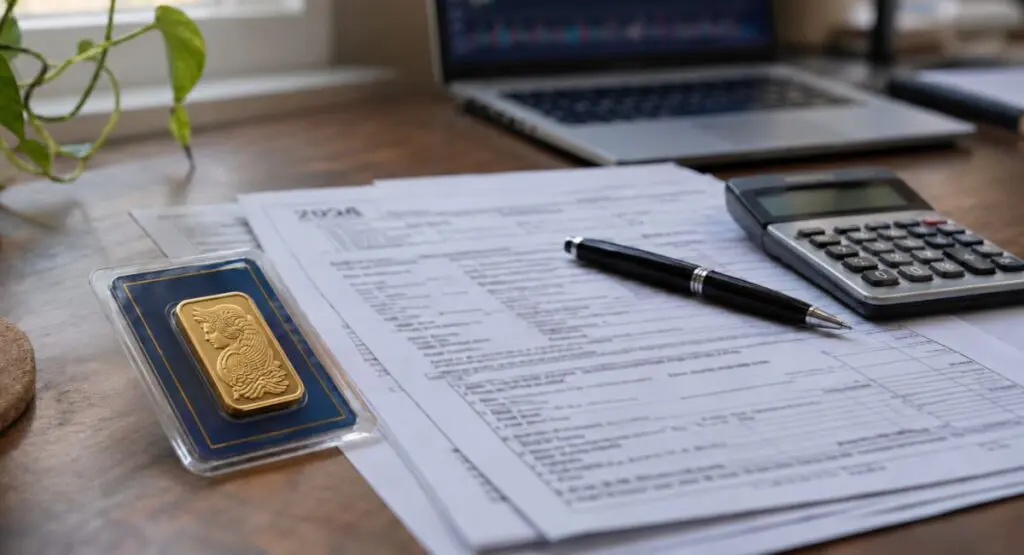
Here is a hypothetical example. A member paid the listed Costco price of $2,399.99 in June 2024 and sells in late October 2026 for $3,944.50, 2% below spot.
- The gain is $1,544.51.
- Taxed at the 28% maximum, the bill would be $432.46.
- The same gain on stock held over a year, at the common 15% rate, would cost $231.68.
$432.46
$231.68
Illustrative maximum-rate comparison. Actual federal tax depends on income, deductions, other gains and losses, and applicable tax rules.
Collectibles gains are taxed at your ordinary rate when it is lower than 28%, so many households will owe less. Gold still tends to lose more to taxes than a stock or fund with the same gain.
How to Get a Better Price Before You Sell
A gold sale is a one-time negotiation, and a few habits make a measurable difference.
- Check the spot price at the moment you ask for quotes, and compare offers as a percentage below spot.
- Get at least three quotes, including one local shop and two online dealers.
- Ask whether an online quote is locked in while the bar is in transit.
- Keep the bar in its sealed assay packaging, the card that certifies weight and purity.
- Look up any buyer with the Better Business Bureau before shipping anything.
Gold buyers who reach out to you first deserve extra suspicion. Unsolicited offers are a common setup for theft, and our report on how many Americans lost money to scams shows how often that pressure works.
Important Questions
Check the Spread Before You Celebrate the Gain
If you bought a Costco bar in 2024 for about $2,400, the gain on paper is real, but the cash you receive will be lower.
Ask three dealers for a bid, divide each offer by the spot price at that moment, and take the highest percentage.
Check the current spot price and calculate each dealer’s offer as a percentage of that price.
Compare at least three quotes and account for shipping, insurance and dealer fees.
Calculate the taxable gain using your documented purchase cost before deciding what you have actually earned.
Then set aside part of the gain for taxes, up to 28% if you held the bar for more than a year.
Filing season for 2026 sales opens in early 2027, and our guide explains how early you can file.
In our view, Costco gold works best as a long-term holding bought at a low premium, not as a quick rewards play.